24時間年中無休のオンラインサービス : +86 13950095727

#Eメール
  • シェア :

  • facebook
  • y
  • t
  • instagram
  • in
ブログ
ホーム / ブログ
Crystallization Control in Thermoplastic Composites: From Mechanism to Application 2026-02-28
Thermoplastic Composite Crystallinity

Thermoplastic Composite Crystallinity: A Comprehensive Overview

Abstract

Thermoplastic composites have transformed materials engineering due to their recyclability, damage tolerance, and manufacturing flexibility. At the core of their performance lies crystallinity, a molecular-scale phenomenon governing nearly all composite behaviors, from tensile strength to chemical resistance.

In semi-crystalline thermoplastics such as polyphenylene sulfide (PPS) and polyetherketoneketone (PEKK), crystallization creates a complex interplay between ordered crystalline regions and disordered amorphous domains. Modern manufacturing technologies, including automated fiber placement (AFP) and automated tape laying (ATL), introduce both opportunities and challenges for crystallinity control.

This report synthesizes recent advances in crystallization mechanisms, analyzes relationships between processing parameters and material performance, and provides insights for optimizing composite properties through crystallinity management.

Fundamentals of Thermoplastic Matrix Crystallization

Molecular Basis of Polymer Crystallization

Semi-crystalline thermoplastics derive their distinctive properties from a hierarchical self-assembly process:

  • Polymer chains fold into lamellar structures (10–20 nm thick) upon cooling.
  • Lamellae organize into spherulitic regions (up to 100 μm diameter).

Degree of crystallinity (Xc) typically ranges 20–60% and depends on:

  • Restricted chain mobility due to aromatic backbone rigidity
  • Heterogeneous nucleation at the fiber–matrix interface
  • Kinetic limitations from rapid cooling rates

The Avrami equation describes crystallization kinetics:

X(t) = 1 - exp(-k t^n)
X(t): degree of crystallinity; k: crystallization rate; n: Avrami exponent

For carbon fiber–reinforced PPS (CF/PPS) under isothermal conditions (225–240 °C), n ≈ 1.65–1.75, indicating mixed nucleation influenced by fiber surfaces.

Fiber–Matrix Interaction and Transcrystallinity

Carbon fibers act as nucleating agents, forming a transcrystalline layer (TCL) at the fiber–matrix interface:

  • TCL thickness: 5–20 μm
  • Formed when:
    • Fiber surface provides heterogeneous nucleation sites
    • Temperature gradients promote directional crystal growth
    • Cooling rates are below the critical quenching threshold (~100 °C/min for PPS)

Effect on mechanical performance:

  • Interfacial shear strength increases by 14.2%
  • Excessively thick TCL (>15 μm) may reduce toughness

Crystallinity–Property Relationships

Mechanical Performance

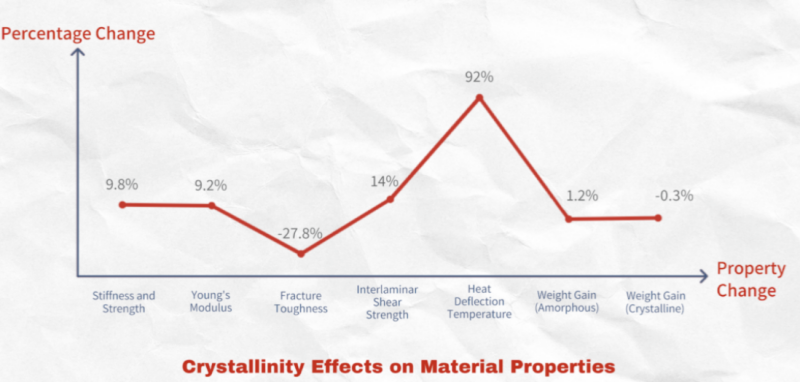
  • Stiffness & Strength: Crystallinity 51% → 62%: Storage modulus ↑ 9.8%, Young’s modulus ↑ 9.2% (nonlinear beyond 50%)
  • Fracture Toughness: Crystallinity 17% → 44% reduces Mode I toughness by 27.8%; optimal at 30–35%
  • Interlaminar Properties: Slow cooling (0.5 °C/min) ↑ ILSS 14%; High-speed AFP (>5 m/min) ↓ ILSS 18%

Thermal & Chemical Stability

  • HDT: 135 °C → 260 °C (20% → 60% Xc)
  • Chemical resistance: weight gain in fuel immersion 1.2% → 0.3%
Crystallinity vs Properties

Processing Parameter Optimization

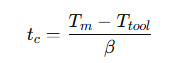
Cooling Rate Control

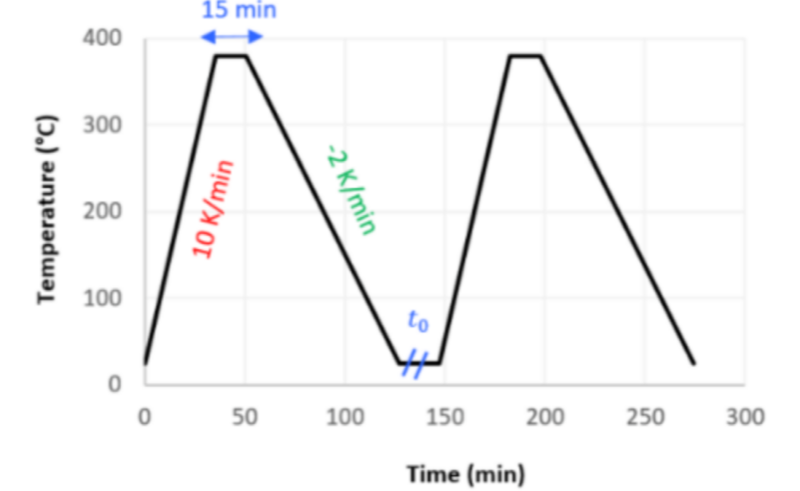
Maintaining a proper crystallization window balances properties. Example: CF/PPS mold temperature 87–270 °C allows isothermal crystallization. Laser 380 °C, mold 120 °C → Xc 44.1%, cycle time reduced 80%.

Mold Temperature Effects

  • Affects cooling gradient, crystal growth, and residual stresses
  • Increasing Ttool 40 °C → 120 °C raises Xc 17.6% → 44.1%
Xc = Xc,0 * exp(-Ea / (R*T))
Maintaining Ttool > 87 °C allows spherulites ~10 μm

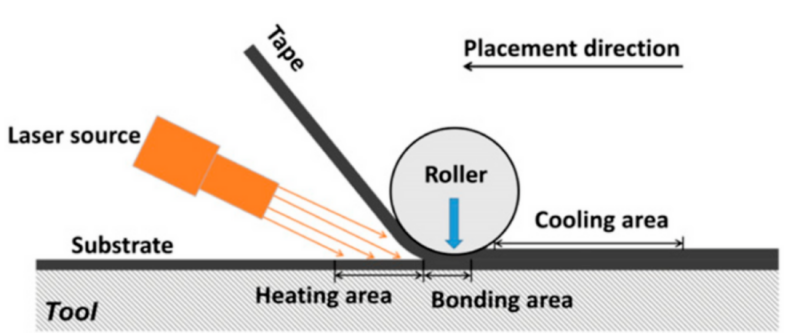
Laser Energy Input and Placement Speed

  • Higher laser temperature melts polymer microcrystals and enhances mobility
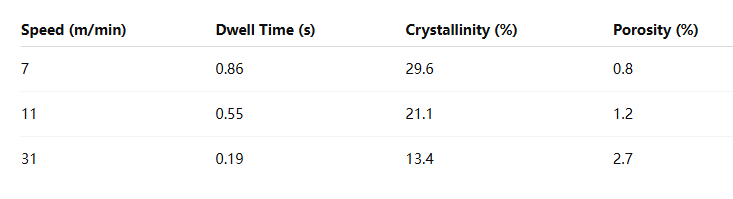
  • Placement speed: faster → shorter crystallization → lower Xc
  • Post-annealing recovers 60–80% Xc
Laser-assisted AFP Placement speed vs Crystallinity Cooling rate vs Crystallization time

Advanced Characterization Techniques

Differential Scanning Calorimetry (DSC)

  • Cold crystallization (Tcc) during heating
  • Melting peak (Tm)
Xc = (ΔHm - ΔHcc) / ΔHm⁰ × 100%
ΔHm⁰ = 80 J/g for PPS
DSC Thermogram

Scanning Electron Microscopy (SEM)

  • Transcrystalline layers 5–15 μm along fibers
  • Spherulites 10–50 μm
  • Interlaminar fracture through amorphous regions
  • EDS: sulfur enrichment in crystalline regions

X-ray Diffraction (XRD)

Hermans orientation function:

f = (3⟨cos²φ⟩ - 1)/2
φ = angle between polymer chain and fiber axis

Highly oriented TCL: f ≈ 0.8–0.9; Bulk spherulites: f ≈ 0.2–0.3

Industrial Implementation

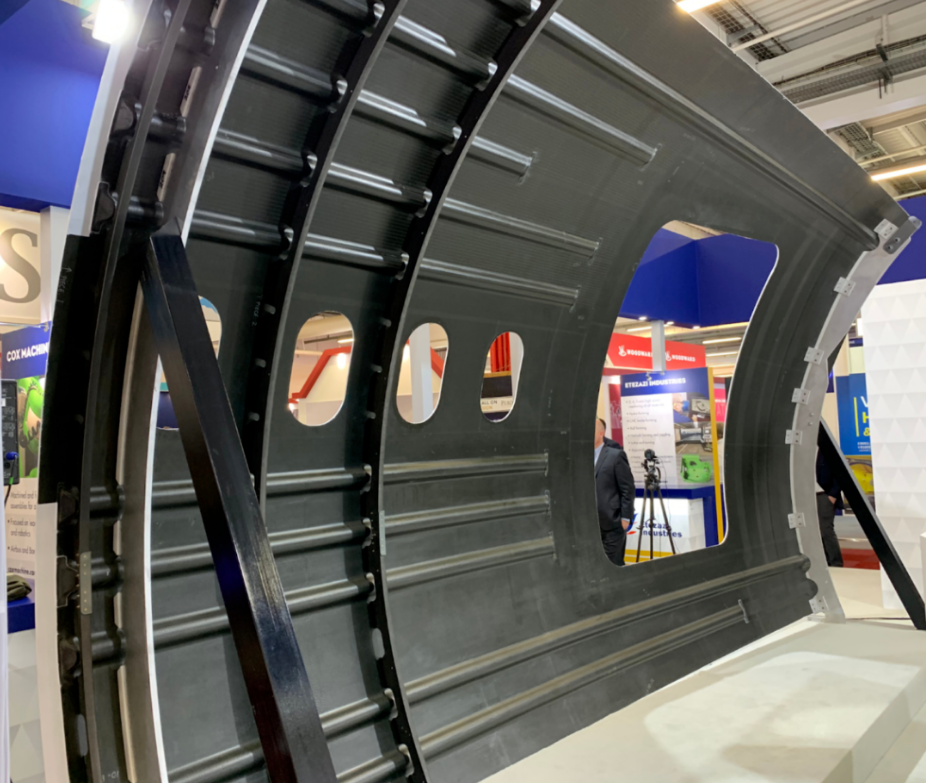
Aerospace – CF/PEKK Fuselage Panels

Boeing 787 Dreamliner: CF/PEKK, Xc 35–40%

  • Consolidation time reduced 85%
  • Weight reduced 12%
  • Service temperature up to 200 °C
  • Laser 400 °C, Mold 150 °C, Speed 5 m/min, Cooling 50 °C/min
Boeing 787 CF/PEKK Panel

Automotive – CF/PPS Battery Trays

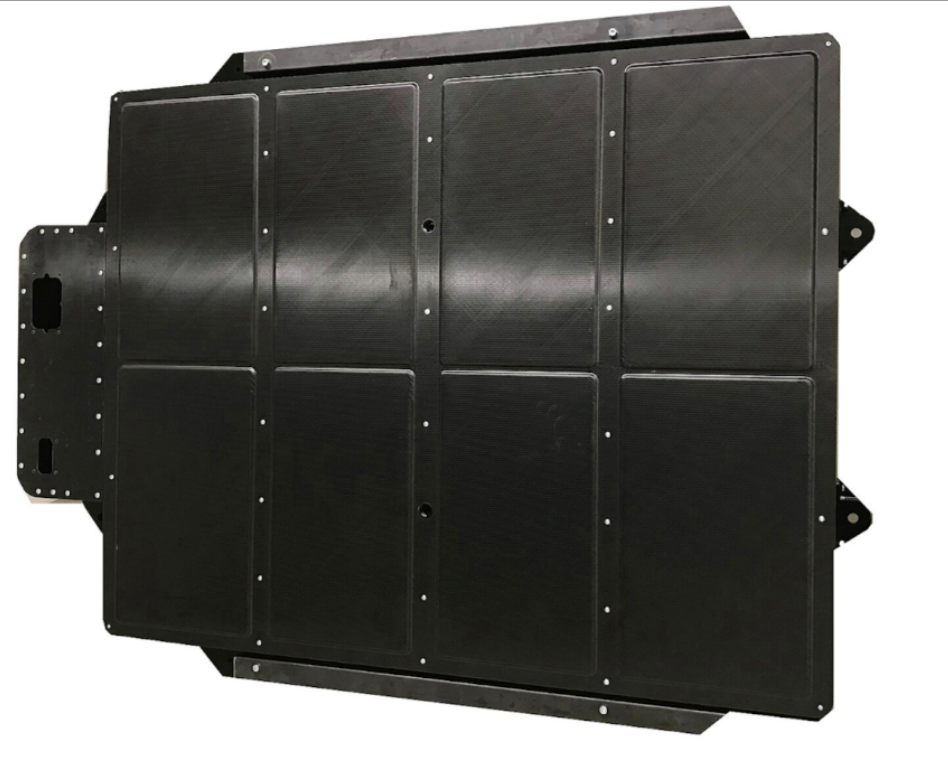
BMW i3: AFP CF/PPS, Xc 28%

  • ILSS 45 MPa, Impact toughness 8 kJ/m²
  • Cycle time 30 s/layer
  • Post-IR annealing → Xc 35%
BMW i3 Battery Tray

Future Directions

  • Machine Learning: predict Xc within 2% accuracy
  • Nanoparticle nucleation: 0.5 wt% graphene oxide → faster crystallization
  • In situ monitoring: Fiber Bragg sensors detect Xc in real time
  • Morphology–Performance Mapping: Digital twins correlate spherulite distribution with fatigue life

Conclusion

Crystallinity control is key to thermoplastic composite performance. By regulating:

  • Cooling rate: 2.5–10,000 °C/min
  • Mold temperature: 40–280 °C
  • Placement speed: 5–31 m/min
  • Achieve Xc: 17–62%

Emerging technologies like ML and in situ sensors can reduce development cycles by 70% while improving material utilization.

ニュースレター

-- 最新のトピックで最新情報を入手する

著作権 © 2015-2026 Xiamen LFT composite plastic Co.,ltd..すべての権利予約.

ホーム

製品

 ニュース

接触